


Understanding HRIS modules: what you actually need
Modern HRIS platforms aren't monolithic systems anymore. They're modular; a bit like building blocks where you select the pieces that matter to your organisation. Understanding what's available and what you genuinely need prevents you from paying for functionality that'll gather digital dust.
The core modules (nearly everyone needs these):
Employee data management
The foundation of any HRIS. Stores all employee information; personal details, job history, contracts, documents. This isn't exciting, but it's essential. Without clean, centralised employee data, nothing else works properly.
Organisational management
Tracks your company structure, reporting lines, departments, locations, and cost centres. Sounds basic, but managing organisational changes efficiently makes a material difference to HR admin burden. Systems that handle restructures elegantly save enormous amounts of time.
Time and absence management
Tracks holiday requests, sickness, other leave types. Calculates entitlements, handles accruals, manages approval workflows. For many organisations, this delivers the quickest wins in terms of reducing admin overhead and improving manager experience.
Modern HRIS platforms aren't monolithic systems anymore. They're modular; a bit like building blocks where you select the pieces that matter to your organisation. Understanding what's available and what you genuinely need prevents you from paying for functionality that'll gather digital dust.
The core modules (nearly everyone needs these):
Employee data management
The foundation of any HRIS. Stores all employee information; personal details, job history, contracts, documents. This isn't exciting, but it's essential. Without clean, centralised employee data, nothing else works properly.
Organisational management
Tracks your company structure, reporting lines, departments, locations, and cost centres. Sounds basic, but managing organisational changes efficiently makes a material difference to HR admin burden. Systems that handle restructures elegantly save enormous amounts of time.
Time and absence management
Tracks holiday requests, sickness, other leave types. Calculates entitlements, handles accruals, manages approval workflows. For many organisations, this delivers the quickest wins in terms of reducing admin overhead and improving manager experience.
Self-service portals
Lets employees and managers handle routine tasks themselves; updating personal details, booking holiday, accessing payslips, viewing team information. Arguably the module that delivers most immediate value by shifting simple tasks away from HR administrators.
Reporting and analytics
Basic workforce reporting; headcount, turnover, absence rates, diversity metrics. Every HRIS includes some reporting capability, but the quality varies enormously. Some offer drag and-drop report builders, others require technical expertise to extract anything useful.
The extended modules (depends on your requirements):
Recruitment and onboarding
Manages the entire hiring process from job posting through to day-one onboarding. Some organisations prefer standalone ATS platforms with deeper recruitment functionality. Others value having recruitment integrated within their core HRIS for better data flow and simpler vendor management.
Performance management
Handles objective setting, performance reviews, continuous feedback, development plans. Ranges from simple annual review tracking to sophisticated continuous performance management with 360-degree feedback and competency frameworks.
Learning and development
Tracks training completions, manages learning content, assigns mandatory training, monitors compliance training. Some are basic training trackers, others are full learning management systems with course authoring and e-learning delivery.
Compensation and benefits
Manages salary reviews, bonus calculations, benefits enrolment, total reward statements. Particularly valuable for organisations with complex compensation structures or frequent review cycles.
Succession planning and talent management
Identifies high performers, maps succession for critical roles, tracks development progress for future leaders. More relevant for larger organisations with formal talent programmes.
Employee engagement and pulse surveys
Regular employee feedback collection, engagement scoring, action planning. Some HRIS vendors include this, others integrate with specialist engagement platforms.drop report builders, others require technical expertise to extract anything useful.
Workforce planning and analytics Advanced analytics, predictive modelling, scenario planning, workforce cost forecasting. Goes beyond basic reporting into strategic workforce planning territory.
Health and safety
Incident reporting, risk assessments, compliance tracking, workplace safety management. Critical for organisations with significant health and safety requirements, less relevant for purely office-based operations.
Expenses and travel
Manages expense claims, approval workflows, reimbursement processing, travel booking. Sometimes bundled with HRIS, sometimes handled by separate finance systems.
How to decide what you actually need Start with your documented blueprint from section 2. Which modules solve problems you're actively facing? Which align with your strategic priorities?
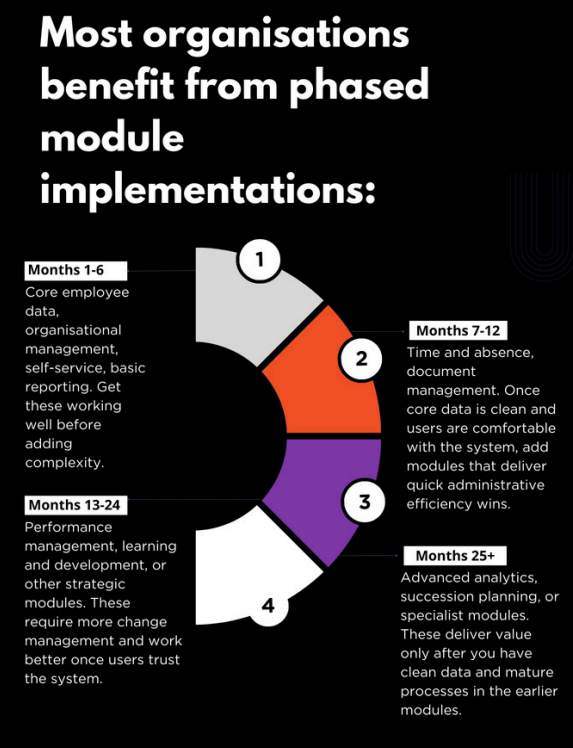
Consider implementation capacity Implementing multiple modules simultaneously stretches resources thin and increases risk. Most successful implementations start with core modules, prove value, then expand.
Evaluate integration requirements
If you already have systems handling certain functions well, you might not need those HRIS modules. A standalone learning management system with strong content libraries might serve you better than a basic HRIS learning module. However, every additional system means another integration to maintain, another vendor relationship to manage, and more complexity for users.
Question bundled modules carefully
Some vendors include modules in their standard package that you'll never use. Others charge separately for everything. Neither approach is inherently better; it depends on your specific needs.
Assess module maturity
Not all modules within an HRIS are equally mature. A vendor might have excellent core HR functionality but basic performance management that hasn't been updated in years. During demonstrations, test the specific modules you're considering, not just the vendor's flagship capabilities.
Document management
Centralised storage for HR documents, electronic signatures, version control, automated reminders for document renewals. Reduces physical paperwork and ensures important documents don't get lost.
Think about user adoption
More modules mean more complexity for users to navigate. An HRIS with 15 modules might look impressive, but if employees can't find what they need because the interface is cluttered, adoption suffers. Sometimes less is more.
Consider your growth trajectory
If you're planning significant expansion, think about which modules you'll need in 18-24 months, not just today. It's easier to activate modules within your existing HRIS than to bolt on completely new systems later. However, don't pay for functionality you won't need for years; priorities change, and you might end up with expensive modules you never implement.
The phased approach
This phased approach reduces implementation risk, allows teams to build confidence gradually, and ensures you're not paying for modules sitting unused whilst you're still implementing basics.
The integration question
For each module, ask: is this better handled within our HRIS or with a specialist tool?
Favour HRIS modules when:
- You need tight integration with employee data
- Your requirements are relatively straightforward
- You want to minimise vendor relationships
- Users will benefit from single sign-on and unified interface
- You lack resources to manage multiple systems
Favour specialist tools when:
- You need sophisticated functionality the HRIS can't match
- You already have an excellent system in place
- The HRIS module is demonstrably weak or immature
- You need specific features only specialist vendors provide The cost difference is significant
Common mistakes to avoid
Buying modules "for the future" Vendors love selling comprehensive packages with modules you'll "grow into. " Your priorities will change, better solutions will emerge, and you'll resent paying for unused functionality.
Assuming modules work together seamlessly
Just because modules come from the same vendor doesn't guarantee they integrate well. Some vendors have acquired multiple products and bundled them together without proper integration. Test cross-module workflows during demonstrations.
Neglecting the basics
Advanced analytics and AIpowered insights sound exciting, but they're worthless if your core employee data is inaccurate. Make sure foundational modules work brilliantly before adding sophisticated capabilities.
Underestimating configuration complexity
Some modules require extensive setup; building competency frameworks for performance management, creating learning curricula, configuring complex approval workflows. Factor this work into your implementation planning and resource allocation.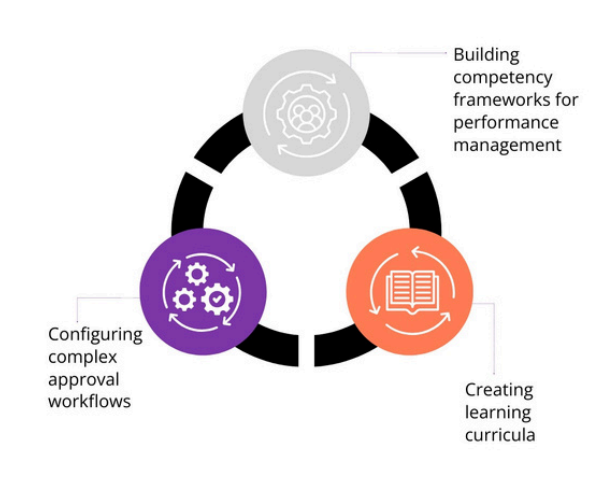
The practical reality
Most organisations start with core HR and self-service modules, add time and absence management quickly because it delivers obvious value, then gradually expand based on evolving priorities. This pragmatic approach reduces risk and ensures you're solving real problems rather than implementing modules because they're included in the package.